Ecommerce
Is Shopify Plus worth it for a UK brand?
By Felix Grant5 min read
Shopify Plus is worth it when you need something only Plus does: a heavily customised checkout, many B2B price lists, several separate stores, or the capacity for big launches and ERP integrations. On card fees alone it rarely pays off until a brand is taking several hundred thousand pounds a month online. Shopify's UK pricing page lists Plus from £1,800 a month, against £259 a month for Advanced on annual billing, checked in November 2026.
Cost
What Plus actually costs
Shopify's UK pricing page shows Plus from £1,800 a month, on a one or three year term. Advanced is £344 a month, or £259 a month billed annually. Shopify's US pricing shows a lower rate for the three year term than for one year, so ask what the term changes before you sign.
The headline fee is not always the fee. Shopify says larger and more complex businesses pay a variable platform fee based on revenue and business model instead of the fixed price, and it does not publish the percentage or the threshold. If your revenue is high enough for that to apply, get the rate, the revenue it is calculated on and any minimum in writing.
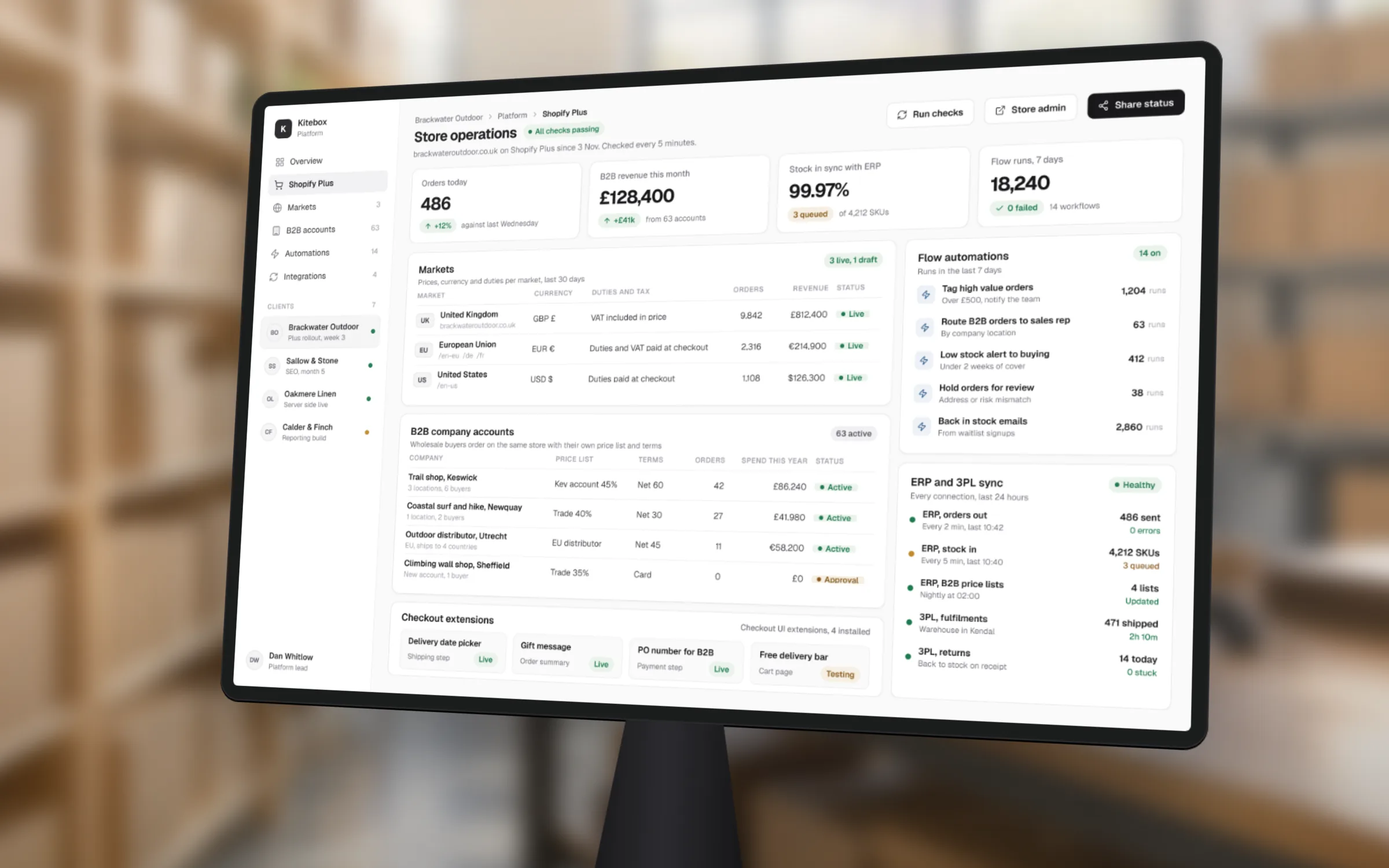
Then add what sits around the platform. Plus stores usually carry more apps, an ERP or warehouse integration, and developer time for checkout extensions and custom functions. The subscription is often the smaller part of the total cost of running a Plus store.
Budget for the move itself as well. Upgrading from Advanced keeps your data and URLs, so it is mostly configuration, testing and any checkout work. Moving to Plus from another platform is a full migration, with redirects, data and tracking to plan, and should be priced as one.
The maths
When the fees pay for themselves
Plus has lower payment rates. With Shopify Payments, UK online card rates are listed at 1.5% plus 25p on Advanced and 1.3% plus 25p on Plus. If you use a third-party payment provider, Shopify's own transaction fee falls from 0.6% to 0.2%.
Take the gap between Plus at £1,800 and Advanced at £259 a month: roughly £1,540. Saving 0.2 percentage points on card fees, you would need around £770,000 a month of card revenue for the lower rate to cover that gap. On a third-party provider, saving 0.4 points, the break-even is around £385,000 a month. Below those figures, the case for Plus has to rest on features, not fees.
Run this on your own numbers, with current rates from Shopify's pricing page, and include the variable fee if it applies to you. A brand doing £150,000 a month online is paying a premium for Plus. That premium can still be worth it, but only if the features solve a real problem.
Below the break-even, Plus has to earn its place on features.
Features
What you actually get over Advanced
Checkout customisation is the biggest difference. Plus lets you add checkout extensions and custom logic for discounts, shipping and payment methods. Shopify Scripts, the old way of doing this, stopped running on 30 June 2026, so this now means Shopify Functions and checkout extensibility. If you were on Plus for Scripts, check what has been migrated.
B2B is the second. Every standard plan now includes Shopify B2B, limited to three catalogues. Plus has unlimited catalogues, which matters once you have different price lists for different trade customers or regions.
Then scale. Plus includes up to nine expansion stores, unlimited staff accounts, more inventory locations, higher API limits on some APIs for integrations, high-volume checkout and bot protection for launches, and priority phone support. Shopify also lists Plus-only features such as combined listings and custom user groups.
Several things people assume are Plus-only are not. Shopify Markets for selling in other currencies and the Flow automation tool are available on standard plans too. Check the current plan comparison before paying for something you already have.
When
When Plus pays off, and when it doesn't
Plus tends to pay off for brands that sell to trade and retail from one platform with many price lists and payment terms, run separate stores for the UK, EU and US with different ranges or legal entities, need checkout logic that apps cannot handle, sync stock and orders with an ERP at volume, or run drops and sales where traffic spikes hard.
It rarely pays off for a single-market brand with a straightforward catalogue, a handful of trade customers and no checkout changes. In that case Advanced with good apps and well-built tracking usually does the job for a fraction of the cost.
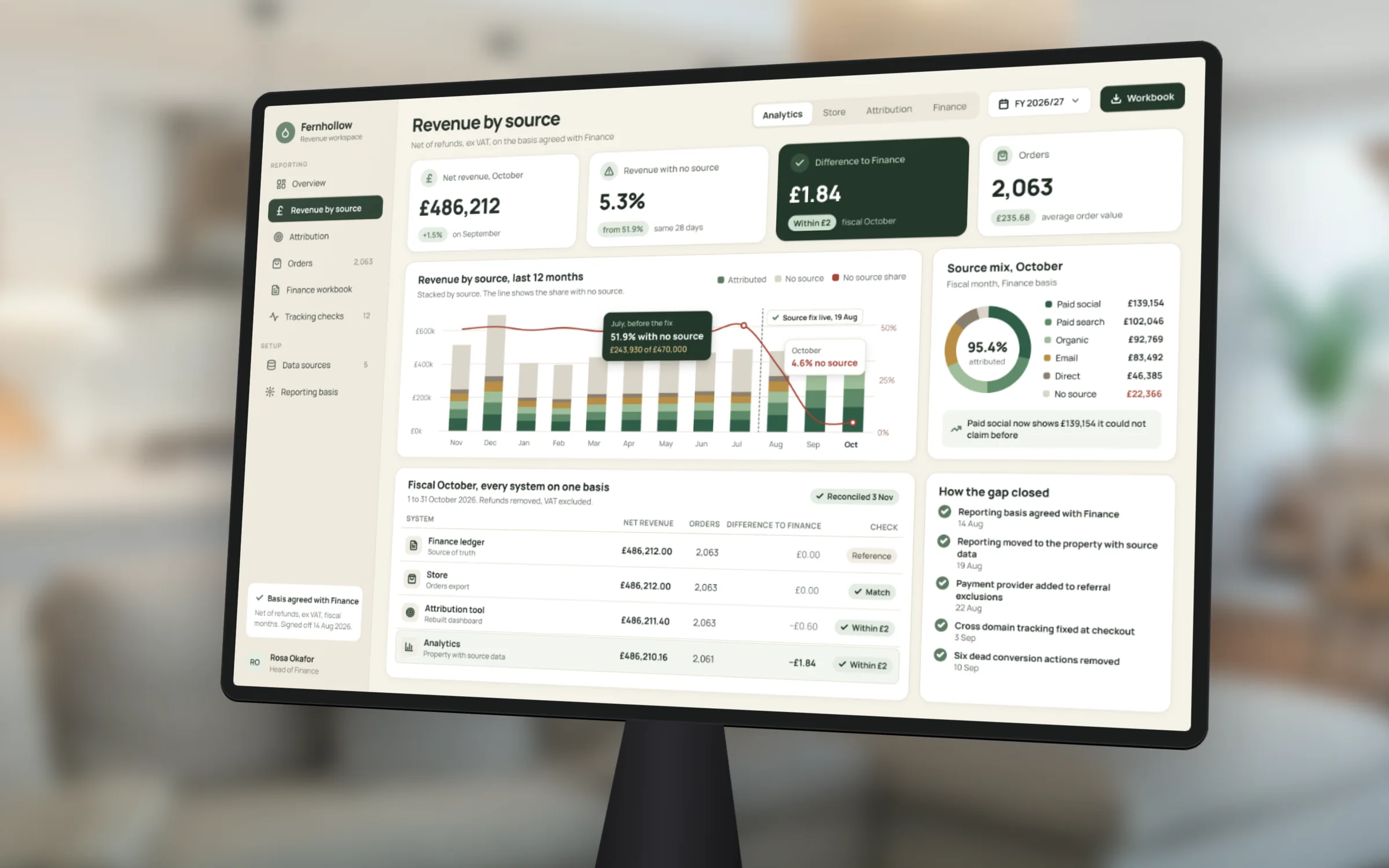
The common mistake is upgrading to fix a problem Plus does not solve. A slow theme, poor conversion rate or broken GA4 tracking will be just as slow, poor and broken on Plus. On one Plus store we reconciled reported revenue to the Finance figures within £2, and the work involved was tracking and data, not anything the plan provided.
Alternatives
The alternatives worth weighing
Staying on Advanced is the first alternative, and often the right one. Use the three B2B catalogues, Markets and Flow, and only move when you hit a specific limit you can name.
BigCommerce suits some B2B-heavy catalogues and does not charge its own transaction fees on third-party gateways. Adobe Commerce suits businesses with complex, custom catalogue and pricing rules and an in-house development team, at a much higher running cost. A headless build on any platform gives the most design freedom and the most code to maintain. For most UK brands between £1 million and £10 million a year, the realistic choice is Advanced or Plus.
Whatever you compare, price it over three years: platform fees, payment fees on your forecast revenue, apps, integrations and development. The cheapest monthly plan is not always the cheapest platform.
Decide
How to decide
List the problems you want Plus to solve, and check each one against the current plan comparison. Work out your break-even on payment fees with real revenue figures. Ask Shopify for a written quote, including the term and any variable fee. Then price the build and integrations, not just the subscription.
Be wary of the reverse argument too. An agency or app vendor recommending Plus because it makes their work easier is not a business case. Ask them which specific feature you need, what it would cost to get the same result on Advanced, and what changes in your numbers if you upgrade. If nobody can answer those three questions with figures, you are not ready to move.
If you are weighing up the move, our £1,950 audit looks at your store, apps, integrations and tracking and tells you plainly whether Plus is worth it for you. If you go ahead, the audit fee is credited against a fixed-quote build.
Key takeaways
- Plus starts from £1,800 a month in the UK, with a variable fee for larger brands
- On card fees alone, Plus rarely pays off below several hundred thousand pounds a month
- Checkout customisation, unlimited B2B catalogues and expansion stores are the real reasons to upgrade
- Markets, Flow and basic B2B are already on standard plans
- Price any platform over three years, including apps, integrations and payment fees

Written by
Felix Grant
Founder of Kitebox, a business technology and AI consultancy that builds what it recommends. Based in Mallorca, working with UK businesses.
About Felix →